
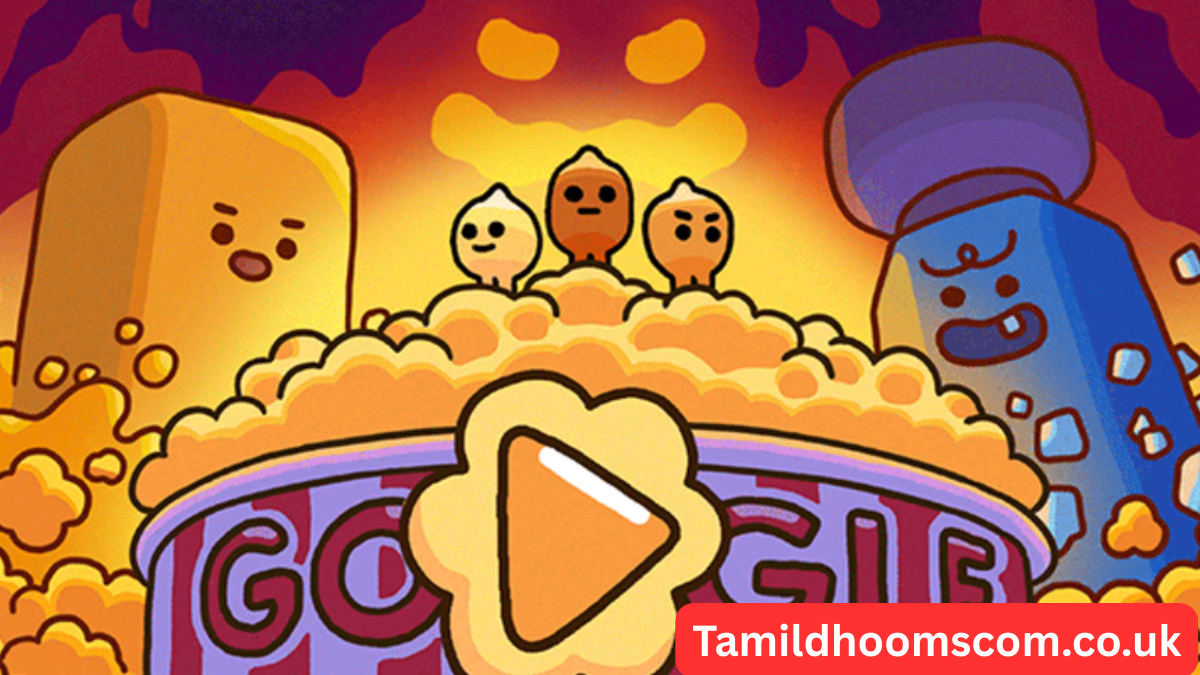
What the Popcorn Google Doodle Actually Is and Why It Became So Popular
The Popcorn Google Doodle is one of those unexpected digital surprises that managed to turn a simple snack into a surprisingly engaging interactive experience. At its core, it is a browser-based mini game created by Google as part of its long tradition of celebrating cultural moments, holidays, inventions, and fun global themes through its homepage logo. In this case, popcorn becomes the central character, reimagined in a playful and competitive environment that feels both nostalgic and modern at the same time.
Unlike static doodles from earlier years, this one is interactive, meaning users actively participate instead of just observing. That shift alone changes the entire experience. Instead of reading or watching something passively, users click, tap, or engage in simple controls that simulate popcorn kernels popping in real time. The simplicity is intentional, but the execution makes it unexpectedly addictive. It taps into that universal satisfaction people get from small, quick feedback loops.
What makes it even more interesting is how something as ordinary as popcorn becomes a full-blown game mechanic. The designers didn’t just animate popcorn; they gave it personality, behavior patterns, and even competitive tension. This turns a basic snack into something almost character-like, which is exactly the kind of creative twist Google Doodles are known for. Over time, this doodle gained attention not just as a fun distraction, but as a clever example of interactive storytelling in micro-form.
The History and Evolution of Google Doodles Leading to Popcorn
To understand why the Popcorn Google Doodle exists in the first place, it helps to look at the broader evolution of Google Doodles. What started as a simple “out of office” joke by Google’s founders in 1998 gradually turned into a global creative platform. The early doodles were static illustrations placed behind the Google logo to mark events like holidays or anniversaries of famous people.
As time went on, these doodles became more complex and experimental. Engineers and artists at Google began collaborating to push boundaries beyond static images. Eventually, animation entered the scene, followed by fully interactive experiences. This evolution reflects not just technological progress but also a shift in how people engage with short-form digital content. Attention spans changed, devices changed, and doodles adapted accordingly.
By the time the Popcorn Google Doodle was introduced, users were already familiar with interactive doodles like games celebrating Pac-Man anniversaries or global cultural festivals. Popcorn was a natural continuation of this trend. It didn’t try to be overly serious or educational in a traditional sense. Instead, it leaned into entertainment, quick engagement, and visual satisfaction. That makes it part of a larger lineage of doodles that prioritize experience over explanation, while still subtly teaching design and interaction principles.
How the Popcorn Doodle Gameplay Works in Practice
At first glance, the Popcorn Google Doodle looks extremely simple, but the gameplay mechanics are carefully designed to create engagement. The basic idea revolves around popcorn kernels popping in response to user interaction or timed triggers. Depending on the version or variation, users might click to “pop” kernels or manage popping sequences under certain constraints.
The simplicity is intentional because it removes barriers to entry. There are no instructions that require deep reading or learning curves that discourage casual users. Instead, the game relies on intuition. People naturally understand popping mechanics because popcorn itself is universally familiar. That familiarity reduces cognitive load and allows players to immediately focus on the experience rather than the rules.
As the game progresses, subtle layers of difficulty or variation may be introduced. These can include timing challenges, chain reactions, or limited actions that require strategic thinking. While it never becomes a hardcore game, it does create just enough complexity to keep users engaged for longer than expected. This balance between simplicity and depth is one of the strongest design features of the doodle.
Another important aspect is feedback. Every action produces a visual or auditory response, reinforcing the sense of interaction. This is crucial in short-form games because it keeps the experience satisfying even if it only lasts a few minutes. The Popcorn Doodle understands this psychology well and uses it to maintain player interest without overwhelming them.
Design Philosophy Behind the Popcorn Google Doodle
The design of the Popcorn Google Doodle is rooted in a philosophy that prioritizes accessibility, universality, and delight. Google Doodle teams often aim to create experiences that can be understood instantly by people of all ages and backgrounds. Popcorn, as a subject, is perfect for this because it exists in nearly every culture in some form, whether in cinemas, festivals, or home kitchens.
Visually, the doodle uses bright colors, smooth animations, and soft transitions to create a friendly and inviting atmosphere. Nothing feels harsh or overly complex. Even the movement of popcorn kernels is designed to feel organic and satisfying, almost like a visual representation of sound and motion combined. This attention to sensory harmony is part of what makes the doodle memorable.
Another key design decision is minimalism. Despite being interactive, the interface avoids clutter. There are no unnecessary buttons, no complicated menus, and no distractions from the core activity. This allows users to focus entirely on the popping experience. It also ensures that the doodle performs well across devices, from high-end desktops to low-spec mobile phones.
The designers also likely considered emotional response. Popcorn is associated with entertainment, relaxation, and social experiences like watching movies. By tapping into those associations, the doodle creates a subtle emotional connection that goes beyond gameplay. It feels familiar, comforting, and lighthearted, which increases its shareability and replay value.
Cultural Meaning and Symbolism of Popcorn in the Doodle

Popcorn might seem like a simple snack, but culturally it carries a lot of meaning, and the Google Doodle subtly leverages that symbolism. In many cultures, popcorn is tied to celebration and leisure. It is commonly eaten during movies, fairs, and gatherings, making it a symbol of shared enjoyment and entertainment.
In the context of the doodle, popcorn becomes more than food—it becomes a metaphor for small moments of joy. Each pop represents a tiny burst of satisfaction, and when multiplied across the game, it creates a rhythm of continuous delight. This aligns with modern digital design trends where micro-interactions are used to enhance user experience.
There is also a playful sense of chaos embedded in popcorn itself. When kernels pop, they move unpredictably, bounce around, and expand rapidly. This natural unpredictability translates well into game mechanics, making the experience feel alive rather than scripted. The doodle captures this energy and transforms it into controlled interaction.
On a deeper level, the doodle reflects how everyday objects can be reinterpreted through digital creativity. By taking something as ordinary as popcorn and turning it into an interactive experience, the designers highlight the idea that creativity can emerge from the simplest inspirations. That message is consistent with many other Google Doodles, but it feels especially effective here due to the universal familiarity of the subject.
Technical Execution Behind the Popcorn Google Doodle
From a technical perspective, the Popcorn Google Doodle represents a compact but well-optimized piece of web-based interactive design. Google Doodles are typically built using a combination of technologies like HTML5, JavaScript, and CSS animations, and this one follows a similar approach. The goal is to ensure smooth performance across all browsers without requiring additional plugins.
The animation system is likely driven by frame-based or physics-inspired logic, where each popcorn kernel follows a set of rules governing movement, timing, and interaction. This creates the illusion of randomness while still being fully controlled by code. The result is a visually dynamic environment that feels organic without being computationally heavy.
Performance optimization is another key factor. Since Google Doodles appear on the homepage, they must load quickly and run smoothly even on low-bandwidth connections. This means developers carefully balance visual quality with efficiency. Assets are compressed, scripts are minimized, and rendering is optimized to avoid lag or delays.
Responsiveness is also critical. The doodle must adapt to different screen sizes, orientations, and input methods. Whether a user is tapping on a smartphone or clicking with a mouse, the experience should remain consistent. This cross-platform compatibility is a hallmark of modern doodle design and is executed very effectively in the popcorn version.
User Reception and Internet Reaction to the Popcorn Doodle
When the Popcorn Google Doodle launched, it quickly attracted attention from users around the world. People appreciated its simplicity, charm, and addictive gameplay loop. Social media platforms were filled with short clips, reactions, and comments about how unexpectedly fun the doodle was, despite its minimal concept.
One of the strongest aspects of its reception was accessibility. Unlike complex games or apps, there was nothing to download or install. Users could simply open Google and start playing instantly. This frictionless access made it highly shareable and contributed to its viral spread.
Many users also praised the doodle for being a refreshing break from more serious or information-heavy content. It served as a short mental pause in the middle of daily browsing, which is something modern users increasingly value. In a digital environment often dominated by productivity tools and information overload, small playful experiences stand out more than ever.
Critics and design enthusiasts also highlighted the doodle as a strong example of micro-interaction design. It demonstrates how small-scale digital experiences can still be meaningful and engaging when executed with care. The combination of simplicity, responsiveness, and visual feedback made it a standout among recent interactive doodles.
Educational Value Hidden Inside the Popcorn Experience
While the Popcorn Google Doodle is primarily designed for entertainment, it also contains subtle educational elements. One of the most important is cause-and-effect learning. Players quickly understand that their actions directly influence outcomes, reinforcing basic interaction logic.
There is also an underlying introduction to timing and coordination. Depending on the mechanics, users may need to time interactions carefully or anticipate chain reactions. This indirectly teaches basic principles of timing, sequencing, and pattern recognition without explicitly framing them as lessons.
From a design education perspective, the doodle is also a great example of minimal interface design. It shows how a simple concept can be transformed into an engaging experience without overwhelming users with options or instructions. This is valuable for anyone studying user experience or game design.
Additionally, it demonstrates how cultural familiarity can be leveraged in educational design. By using popcorn—a universally known object—the doodle reduces learning friction and allows users to focus on interaction rather than understanding context. This is a powerful principle in both education and design.
Legacy and Influence of the Popcorn Google Doodle
The Popcorn Google Doodle may seem like a small digital experiment, but its influence extends into broader discussions about interactive web content. It reinforces the idea that short, browser-based experiences can still be impactful in an age dominated by large-scale apps and platforms.
One of its lasting contributions is demonstrating how micro-games can drive engagement without complexity. This has inspired similar approaches in web design, advertising, and even educational tools. The idea that a simple interaction can create emotional satisfaction has become more widely appreciated in digital design communities.
It also contributes to the ongoing legacy of Google Doodles as a creative medium. What started as a small branding experiment has evolved into a respected platform for artistic and technical expression. The popcorn doodle fits neatly into this tradition while also showcasing how far the format has evolved.
Even after its initial release, it continues to be referenced in discussions about interactive design. Designers often point to it as an example of how simplicity, when executed well, can outperform complexity. That kind of lasting relevance is what separates memorable doodles from forgettable ones.
Conclusion: Why the Popcorn Google Doodle Still Stands Out
The Popcorn Google Doodle stands out because it transforms something ordinary into something unexpectedly engaging. It doesn’t rely on complex narratives or advanced mechanics. Instead, it focuses on pure interaction, visual satisfaction, and universal familiarity. That combination makes it accessible to almost anyone who encounters it.
It also reflects the broader philosophy of Google Doodles as a whole: creativity doesn’t need to be complicated to be effective. Sometimes, the simplest ideas—like popcorn popping—can become the most memorable experiences when presented with care and imagination.
In a digital world filled with overwhelming content, this doodle serves as a reminder that small moments of interaction can still bring genuine enjoyment. That is ultimately why it continues to be remembered and discussed long after its release.
FAQs
What is the Popcorn Google Doodle?
It is an interactive Google homepage game that turns popcorn popping into a playful digital experience.
When was the Popcorn Google Doodle released?
It was released as part of Google’s ongoing series of interactive doodles celebrating creative and cultural themes.
How do you play the Popcorn Google Doodle?
Users interact by clicking or tapping to trigger popcorn popping actions and enjoy simple gameplay mechanics.
Why did Google make a popcorn-themed doodle?
Because popcorn is a universal symbol of entertainment and fun, making it ideal for an engaging interactive experience.
Is the Popcorn Google Doodle still available?
It may not always appear on the homepage, but archived versions of Google Doodles are often accessible online.
Also read: Carla Diab Net Worth: A Deep Dive Into Her Life, Career, Income Sources, and Financial Success