
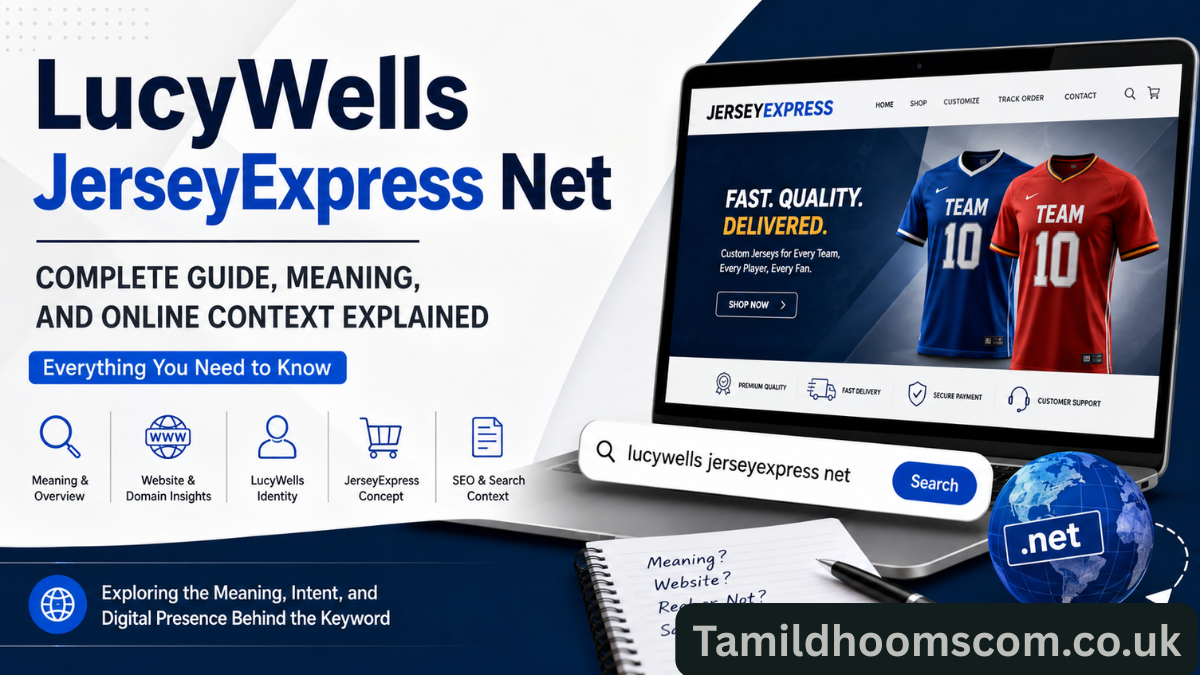
Introduction to “lucywells jerseyexpress net”
When you first come across a keyword like “lucywells jerseyexpress net,” it might feel a bit unusual or even confusing at first glance. That’s pretty normal, especially when you’re dealing with a phrase that looks like a mix of a personal name and a domain-style string. In most cases, such keywords tend to show up in search data, SEO tools, or user queries where people are trying to track a person, a brand, or a website. Sometimes it’s intentional branding, and other times it’s just how search terms naturally evolve online.
From a digital perspective, this kind of keyword usually signals curiosity. People might be trying to find information about someone named Lucy Wells, or they may be trying to reach or understand a platform associated with something like “Jersey Express” under a domain-like structure. The “net” part makes it feel like a website, even if it might not be a real or active domain. That ambiguity is exactly what makes it interesting from an SEO and content analysis point of view.
In this article, we’re going to break this keyword down in a structured way, explore its possible meanings, and understand how such terms function in search ecosystems. We’ll also look at how users interact with these kinds of phrases, what they might be trying to find, and how content creators or marketers might interpret or respond to them. The goal here is not to assume anything blindly, but to analyze it like an expert would in a real-world digital research scenario.
Breaking Down the Keyword Structure
Looking at “lucywells jerseyexpress net,” the first thing that stands out is that it’s not a naturally formed sentence. Instead, it looks like a concatenation of different elements: a name, a brand-like term, and a domain-style suffix. That structure alone tells us a lot about how it might be used in search behavior or SEO indexing.
The first part, “lucywells,” appears to be a personal name. In digital ecosystems, names like this often represent individuals, influencers, authors, or sometimes fictional placeholders used in testing or content generation. Without additional context, it’s not possible to assign a fixed identity, but it does function as a strong keyword anchor because personal names are often used in searches when users are trying to find social profiles, articles, or associated platforms.
The second part, “jerseyexpress,” sounds like a brand or business name. It could suggest anything from a logistics company, a sports jersey retailer, or even a fictional brand used in online content. The combination of “jersey” and “express” often implies speed, delivery, or sports merchandise. In SEO terms, this kind of naming structure is commonly used because it is memorable and keyword-rich.
The final part, “net,” gives the impression of a website domain extension. Even though it is not formatted like a proper URL, its inclusion suggests that users may be searching for an online presence or trying to access a specific website. This is a common pattern in search queries where users don’t remember exact URLs but try to reconstruct them from memory.
Possible Meaning Behind “Lucywells”
The term “lucywells” could represent several different possibilities depending on context. In some cases, it might be a real individual’s name, possibly associated with content creation, business, or social media presence. In other cases, it could be a placeholder identity used in datasets, SEO experiments, or sample content generation.
Names like this often gain traction online when they are tied to niche content or repeated across multiple platforms. For example, if “Lucy Wells” were associated with fashion, sports, or digital branding, users might start searching for related websites or services. This is how search demand builds organically around a keyword.
Another possibility is that “lucywells” is being used in a composite keyword structure for SEO purposes. Marketers sometimes combine names with brand terms to simulate search intent or test ranking behavior. In such cases, the name itself may not refer to a widely known public figure, but rather serve as a structural element in content optimization.
Regardless of its origin, the presence of a name in a keyword like this always signals a human-centered search intent. People are generally trying to find information about a person, their work, or something they are associated with. That makes it an important anchor point for understanding the rest of the phrase.
Understanding “JerseyExpress” as a Concept
The term “jerseyexpress” immediately brings to mind the idea of fast service or delivery related to jerseys, sports apparel, or merchandise. In many online business contexts, “express” is used to indicate speed, convenience, or priority handling. When combined with “jersey,” it often relates to sports jerseys, custom team apparel, or fan merchandise.
In the digital marketplace, names like Jersey Express could easily belong to an ecommerce store specializing in sports clothing. Many such businesses exist globally, catering to fans of football, basketball, cricket, and other sports. They typically offer customization options, allowing customers to print names, numbers, or team logos on jerseys.
From an SEO standpoint, “jerseyexpress” is a strong commercial keyword because it combines a product category with a service promise. This makes it highly attractive for search targeting, especially in competitive niches like sports merchandise. Users searching for it are often already in a transactional mindset, meaning they are closer to making a purchase or exploring services.
However, without a confirmed reference, it’s also possible that “jerseyexpress” is part of a fictional or placeholder brand used in content development or testing environments. This is common in SEO datasets where synthetic keywords are used to simulate real-world search patterns.
The Role of “Net” in the Keyword
The inclusion of “net” at the end of the keyword is particularly interesting because it mimics the structure of a domain name. Even though it is not formatted as a proper URL, it gives the impression that the user is trying to locate a website.
In many real-world search cases, users type phrases like this when they are unsure of the exact domain extension or spelling. Instead of entering a full URL, they rely on partial memory, combining brand names with generic domain indicators like “.com,” “net,” or “online.” This behavior is extremely common in organic search traffic.
From a technical perspective, “net” also adds ambiguity. It can refer to a real domain extension, but in this case, it is not attached to a structured URL format. That suggests the keyword is more likely a search phrase than an actual web address. This distinction is important when analyzing intent and trying to determine what users are really looking for.
In SEO terms, this kind of structure often appears in long-tail keyword searches where users are attempting to rediscover a website they previously visited. It reflects memory-based search behavior rather than precise navigation.
SEO Perspective of the Keyword
From an SEO standpoint, “lucywells jerseyexpress net” is a classic example of a fragmented long-tail keyword. It combines a personal identifier, a brand-like term, and a domain-style suffix, which makes it highly specific but also ambiguous.
Search engines interpret such keywords by breaking them down into components and trying to match them with relevant indexed content. If there is no exact match, they rely on semantic understanding to show related results. This is why such keywords often lead to mixed or generalized search results rather than a single authoritative page.
For content creators, keywords like this are both an opportunity and a challenge. On one hand, they have low competition because they are so specific. On the other hand, they lack clarity, which makes it difficult to target them effectively without additional context.
In many cases, SEO professionals would analyze whether this keyword has search volume, whether it is trending, and what user intent it represents before creating dedicated content around it. Without that data, it remains an exploratory keyword rather than a fully actionable one.
Search Intent Behind the Keyword
Understanding search intent is crucial when analyzing a phrase like this. The intent behind “lucywells jerseyexpress net” could fall into several categories depending on how it is being used.
One possible intent is navigational. The user might be trying to find a specific website associated with this phrase. This is common when people forget exact URLs or are trying to revisit a previously seen page. In this case, the keyword acts like a shortcut memory search.
Another possible intent is informational. The user might be trying to learn who Lucy Wells is, or what Jersey Express represents. This type of search is more exploratory and usually leads to research-based content rather than direct transactions.
There is also a small possibility of commercial intent if Jersey Express is a business. In that case, users might be looking for products, services, or pricing information. However, without confirmation of a real brand, this remains speculative.
Digital Identity and Naming Patterns

In the digital world, names like “lucywells jerseyexpress net” often emerge from how identities are structured online. Personal names, brand names, and domain-like phrases frequently get combined in unexpected ways due to tagging systems, SEO practices, or user-generated content.
This kind of structure is also common in datasets where multiple entities are merged for indexing or testing purposes. It can create hybrid keywords that don’t necessarily exist in real-world branding but still appear in search logs.
From a branding perspective, such combinations are interesting because they show how fluid digital identity has become. A name is no longer just a name; it can become part of a larger search ecosystem that includes products, services, and online presence signals.
Evaluating Online Credibility of Such Keywords
Whenever you encounter a keyword that looks like a domain or brand but doesn’t clearly resolve into a known website, it’s important to evaluate its credibility carefully. Not every keyword that looks like a URL actually corresponds to a legitimate or active site.
One of the first steps is checking whether the domain actually exists and whether it has a secure connection, proper branding, and consistent content. If it doesn’t, then the keyword might simply be a search artifact or a placeholder phrase.
Another important factor is context. If the keyword appears in multiple unrelated places without clear explanation, it might be part of automated content generation or SEO experimentation rather than a real brand identity.
In professional digital analysis, these checks help prevent misinformation and ensure that conclusions are based on verified data rather than assumptions.
Jersey Merchandise Ecosystem Context
If we interpret “jerseyexpress” as part of the sports apparel industry, it fits into a much larger ecosystem of online jersey retailers. This market is highly active, especially around major sports events where fans look for team jerseys, customized apparel, and memorabilia.
Businesses in this space often rely heavily on SEO to attract traffic because users frequently search for specific teams, players, or styles. Keywords like “express” or “official store” are commonly used to signal authenticity and speed of service.
Within this context, a name like Jersey Express would likely be positioned as a fast, customer-focused retailer offering sports merchandise. However, without concrete evidence of a real entity, this remains a conceptual interpretation rather than a factual description.
Content Strategy Around Such Keywords
From a content strategy perspective, a keyword like this would be treated as a low-clarity but potentially high-interest term. The first step would be to analyze whether it generates traffic or appears in search trends.
If it does, content creators would typically build explanatory or informational content around it, just like this article is doing. The goal would be to capture users who are searching for clarification rather than direct product purchases.
Another strategy would be to expand the keyword into related topics, such as sports merchandise, digital identity, or brand search behavior. This helps build topical authority while still addressing the original search intent indirectly.
Broader Interpretation of the Keyword
At a broader level, “lucywells jerseyexpress net” represents how fragmented modern search behavior has become. People don’t always search in clean, structured queries. Instead, they often use partial memories, mixed names, and domain-like phrases to find what they are looking for.
This creates a fascinating challenge for search engines and content creators alike. The goal is no longer just matching keywords, but understanding intent, context, and behavioral patterns behind those keywords.
In that sense, this phrase is less about a specific entity and more about how users interact with digital information systems. It reflects the evolving nature of search itself.
Conclusion
The keyword “lucywells jerseyexpress net” is a layered and ambiguous search phrase that combines elements of personal identity, brand naming, and domain structure. While it does not clearly point to a single verified entity, it offers valuable insight into how users construct search queries in real-world scenarios.
From an SEO and content perspective, it highlights the importance of interpreting intent rather than just matching exact phrases. Whether it relates to a person, a brand, or a misunderstood website, its value lies in the way it represents search behavior patterns.
Ultimately, analyzing such keywords helps us understand the evolving relationship between language, identity, and digital discovery in a more connected online world.
FAQs
What does “lucywells jerseyexpress net” mean?
It appears to be a mixed keyword combining a name, a brand-like term, and a domain-style suffix, often used in search queries.
Is jerseyexpress net a real website?
There is no confirmed information proving it is an active or official website based on the keyword alone.
Who is Lucy Wells in this context?
The keyword does not provide enough verified context to identify a specific individual with certainty.
Why do people search for combined keywords like this?
Users often mix names and brand terms when trying to recall websites or find specific online content.
Is this keyword useful for SEO?
Yes, but only as a long-tail exploratory keyword since it lacks clear commercial intent or established meaning.
Also read: Brandon David Jackson: A Deep Dive into Digital Identity, Context, and Online Presence